February 11–12, 2026
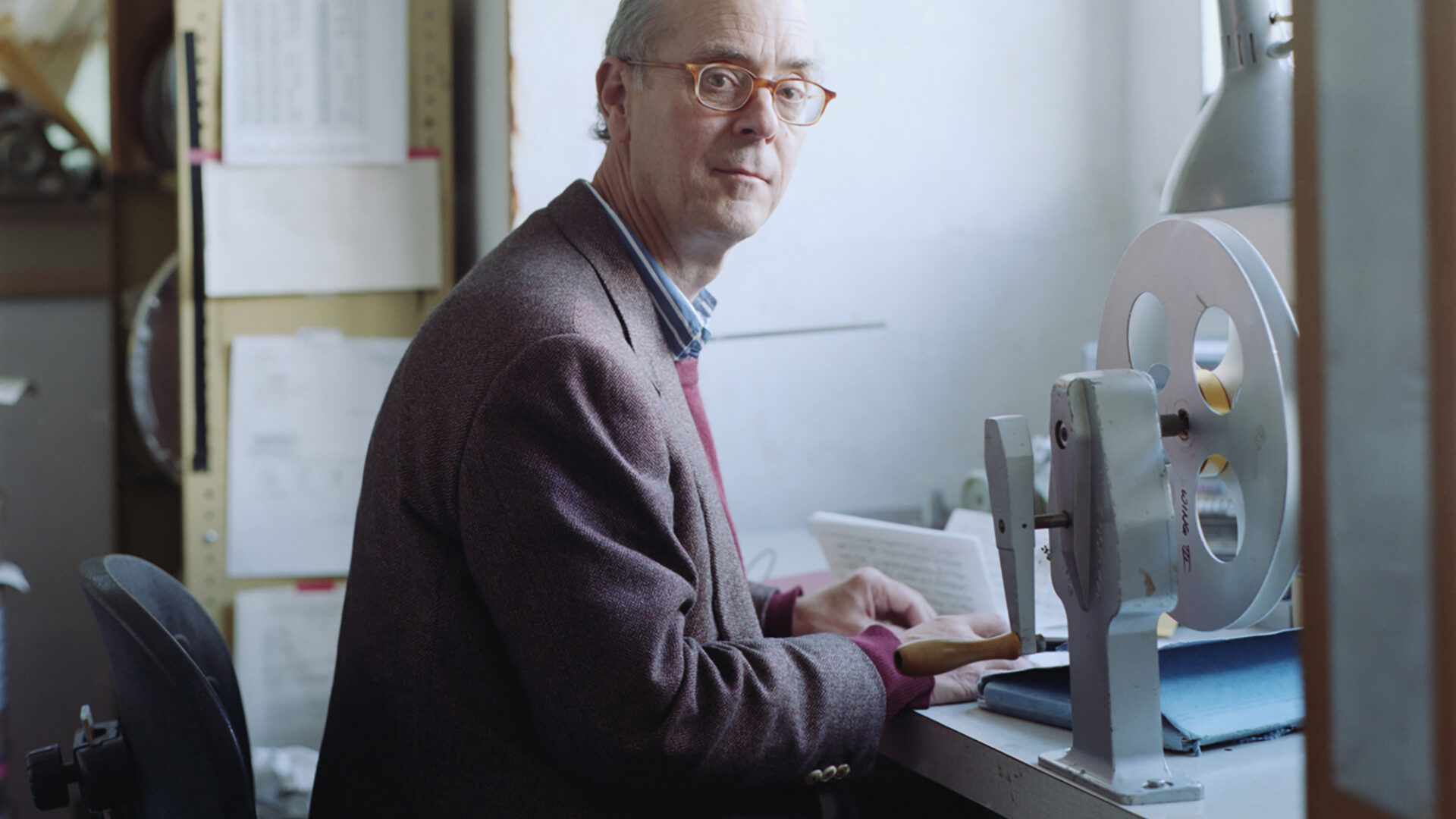
Two Evenings with Robert Beavers
“Beavers’s personal films occupy a noble place within the history of avant-garde film … Perhaps this work’s greatest achievement is that it appears continually fresh, as timeless art should, both to the newcomer and to the fortunate viewer able to savour the richness of these films time and again.”
Susan Oxtoby, TIFF 2000
A working artist for over fifty years, Robert Beavers (b. 1949) has perhaps done more than any other avant-garde filmmaker to both honour and break free from his early inspirations.
Before Beavers pursued an autodidact’s path, Bernice Hodges, a neighbour and craftsperson, introduced him to the world of the Renaissance where, as his biographer Rebekah Rutkoff describes, “No choice had to be made between painting, architecture, music, literature, science, and engineering.” His subsequent meeting and enduring partnership with New American Cinema co-founder Gregory Markopoulos would redirect his path as a young artist and become instrumental to two monumental projects: a film cycle that spanned the entirety of Beavers and Markopoulos’s relationship, and the ongoing restoration of Markopoulos’s films. These two encounters gave Beavers tools, ideas, and models in contrast to traditional education and career tracks in one case; commercial film and the New York avant-garde in the other.
This break was geographic—Beavers and Markopoulos left New York for Europe—and it also opened up his filmmaking practice, providing creative space to work outside the stable containers of film “poetry” or “diary.” This method of drawing on travel and specificities of place continues to guide new work by Beavers to this day. The films, shot via Bolex on 16mm, are ruled by meticulous combinations of elements, both visual and aural, that create frames-within-frames, build rhythm from the isolated sounds of everyday human activity, and merge camera-turret motion with montage. Beavers explores these guiding concepts with a calm vigour that suggests that the entire world might be contained in a single object, so long as it is looked at repeatedly when placed within a lexicon of gestures, shifting states of light, and patterns of colour.
The history of these films is just as particular as their construction. When Beavers and Markopoulos left New York, they removed, for the most part, their films from circulation. When the work re-emerged in the 2000s, even those films completed in the early 1970s were hard to recognize. Citing the sculpting concept of non finito (or the literary practice of Henry James and William Wordsworth), Beavers revisited the work and re-edited each film—all but three significantly shorter and restructured—before placing them in a particular sequence, which he gave the title My Hand Outstretched to the Winged Distance and Sightless Measure. The cycle begins with images of Markopoulos that Beavers shot as a teenager, and ends with the first film he made after Markopoulos’s death.
When his films reappeared in North America, critics soon inserted him into the context—now canonized and well-studied—from which he had originally departed. In one example, he was listed in a New York Times review alongside “Andy Warhol, Joan Jonas, Yvonne Rainer, Michael Snow, and Jack Smith.” These comparisons bring out some of the generalities of his films, in that they show Beavers in a performance of gesture and experience, and their attention to natural portraiture and film materiality is not completely unlike other artists that began working in the 1960s. But his films, painstakingly reworked after that decade, observe particularities of light and space on a different scale than those New York artists, whether across the Mediterranean or across seasons (of a year, of a life). “Since Still Light,” he has said, “I have often combined two locations in one film. Goethe said that you can know one language only by knowing two—I can extend this to say you know one country only by knowing two.”
This first-ever Vancouver presentation of Beavers’s films includes selections from My Hand Outstretched as well as his peripatetic recent works, some of them elegies for friends, others an outflowing of his current partnership with the filmmaker Ute Aurand. Beavers will be present at each screening to discuss his work.
“Beavers has spent his career being precociously ahead of schedule and also somewhat outside his time … In his films there is [a] dreamlike yet clockwork intensity.” Roberta Smith, The New York Times
“A master of cinematic rhythm … Despite their restraint, [Beavers’s] films have an immediate kinetic impact.” Amy Taubin, Village Voice
“One of the few truly original artists working in cinema … Beavers’s film language is a unique merging of actual, living reality with abstract, geometric realities, and the Light.” Jonas Mekas
“One of the most exacting minds and singular sensibilities at work in the movies … Beavers’s mesh of images [is] impelled by emotional, not just formal, necessity.” Nathan Lee, Village Voice
“Beavers’s approach goes beyond that of standard non-commercial filmmaking … One of the most distinctive—and yet underrecognized—bodies of work in cinema.” Chrissie Iles, Artforum
List of Programmed Films
| Date | Film Title | Director(s) | Year | Country |
|---|---|---|---|---|
| 2026-Feb | Robert Beavers: Program One | |||
| 2026-Feb | Robert Beavers: Program Two | |||
| 2026-Feb | Robert Beavers: Program Three | |||
| 2026-Feb | Robert Beavers: Program Four |
Note
Image Credit: Adam Bartos
Special thanks to Robert Beavers, Glenn Fox, Jonathan Marlow, and Susan Oxtoby for their generous assistance in mounting this series.